

50 FOR 50 CHALLENGE
50 for 50 challenge Intro by Lisa Adukia
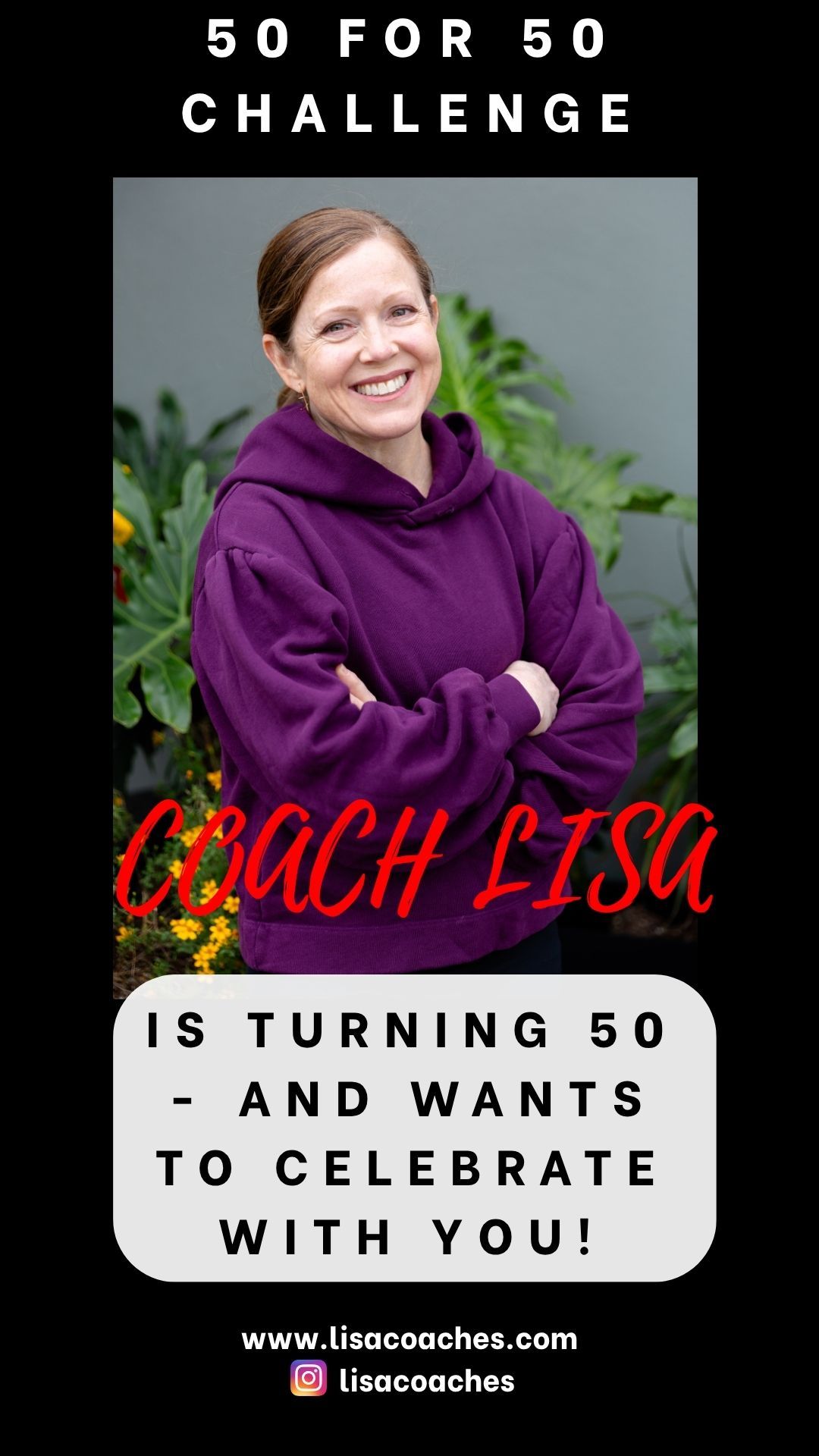
Coach Lisa is turning 50! Celebrate with her by joining the 50 FOR 50 CHALLENGE.
For 30 days, beginning Sept 13th, Coach Lisa will share a new challenge on Instagram @lisacoaches. Reshare a photo or video showing you attempting the daily challenge and tag @lisacoaches to be entered to win 50% off a Personal Training or Health Coaching Package! A name will be randomly selected from all entries at the end of the challenge. Any challenge you can not complete, you can opt to Donate $50 in her name and automatically be entered into the drawing.
THREE WAYS TO JOIN:
Complete any (or all) of the daily challenges, post and tag @lisacoaches
Register and attend any of the events listed below
Donate to Coach Lisa's Favorite non-profit 50 FOR 50 CHALLENGE
UPCOMING EVENTS:
October 8 - Camp Jones Gulch Community Hike [INVITATION}
October 13 - Coach Lisa Turn's 50!
October 18 - Diplo 5k Fun Run & Rave in GGP [REGISTRATION]
October 19 - Challenge Winner Will be Announced on Instagram @lisacoaches
Immediately be entered in the drawing by donating to Coach Lisa's favorite non-profit using the Giving Link below. Every $50 donation will earn one entry into the drawing. GIVING LINK: 50 FOR 50 CHALLENGE
More Events Coming Soon - Follow @lisacoaches on Instagram and check back here for more information and to get involved.
CHALLENGE RECAP:
Join a friend or group for a 50 Minute Walk, Hike, Jog, or Run. Feeling a sense of community improves health and longevity by lowering stress, reducing inflammation, and increasing a person's chance of survival by 50%. [1] (https://pmc.ncbi.nlm.nih.gov/articles/PMC6125010/)
50 Squat Challenge: Level 1: 50 Bodyweight Squats, Level 2: 50 Second Squat Hold, Level 3: 50 lb. Goblet Squats, First Try Level 1, if that feels easy, move on to Level 2, if that feels easy, try Level 3. Tell me how far you got. You do not need a gym or heavy weights to get all the benefits squats offer. Squats help reduce the risk of osteoporosis and are one of the few exercises that can increase bone mineral density in people who already have osteoporosis! For details on the science behind these claims and form tips, check out this article
Donate $50 to my favorite nonprofit - I’ve been serving on the YMCA Embarcadero Advisory Board since 2020. This branch serves families all over San Francisco, with facilities in the Tenderloin, Treasure Island, and SF’s beautiful Embarcadero. It’s one of the longest serving branches in SF, celebrating 100 years of service this year! Donate $50 and be immediately entered into the drawing! Register for one of the upcoming YMCA Community events listed above and get an additional entry for each donation and/or event registration. GIVING LINK: 50 FOR 50 CHALLENGE
Complete 50 Minutes of Strength Training - Take a strength class, or if you can't get to a gym this week, try bodyweight exercises like squats, walking lunges, glute bridges, push-ups, triceps dips, inverted rows, hangs, planks, dead bugs, and burpees. Strength training has many health benefits including; developing strong bones, managing your weight, enhancing quality of life, improving metabolic health, reducing cardio risk, and sharpening your thinking skills. To learn more about the benefits, check out this article
Plank Challenge: Level 1: 50 Second Wall Plank, Level 2: 50 Second Knee Plank, Level 3: 50 Second Full Plank, Level 4: 50 Second Side Plank, Start at Level 1 and share how far you get. Planks are one of my favorite isometric exercises, find a plank that works for your body and gradually increase difficulty. Planks strengthen your core, back, glutes, hamstrings, arms, and shoulders at the same time. Being able to hold a well-executed plank for ≥50 seconds is a great indicator of core endurance, whole-body stability, and muscular control. To learn more variations of Planks from beginner to advanced, check out this Healthline article
50 Gram Challenge: Share one of your nutrient dense meals, containing at least 50 grams of combined protein and fiber. For muscle maintenance/building while reducing body fat, a good 3-meal structure is to make protein the anchor, then add enough carbohydrate to support training and fiber-rich plants, with moderate fat. Fiber is often overlooked, yet is essential for satiety, gut health, metabolic health, and improving the overall nutrient density of the diet. Check out my Protein Navigator to learn more about the importance of protein and this interesting research article to learn more about the Importance of Fiber
50 Band Shoulder Reps: Complete the following 5 band shoulder mobility exercises. 10 Shoulder Up & Overs, 10 Shoulder X's, 10 External Rotations, 10 Band Lat Pull Downs, 10 Band Face Pulls. Resistance bands are excellent for shoulder mobility because they help the shoulder move through a larger, more controlled range of motion while also strengthening the muscles that keep the joint stable. Resistance bands help your shoulders become not only more flexible, but stronger and more stable in that new range of motion. Here is a great article with some additional shoulder exercises to try
50 Second Dead Hang: How long can you hold your own bodyweight? Modern life keeps your shoulders in a narrow range of motion. Desk work rounds them forward. Phone use shortens the anterior chain. Hanging is one of the few movements that pulls the humerus into full overhead flexion under bodyweight, which stretches the capsule and forces the scapular stabilizers to engage. Maintaining grip and upper-body strength is associated with better physical function and independence as people age. The dead hang can be one practical way to train and assess those capabilities. Check out this article, 9 Science-Backed Benefits of Hanging
Share your favorite 50 Challenge so far or use this opportunity to try one you have not yet done. The challenges will start getting more difficult as we get closer and closer to my birthday. If you cannot complete a challenge but still want to get entered into the drawing that day, you can donate $50 to my YMCA Birthday Fundraiser and get an automatic entry.
Walking Lunges for 50 Feet: Few exercises are as effective, accessible, and transformative as walking lunges. They do more than sculpt the legs—they enhance joint stability, improve postural strength, refine balance, and stimulate metabolism, all while engaging the brain. For more detailed instructions and variations, check out this Healthline article
Make 50% of your plate Fruits & Vegetables: Making about half of your meals fruits and vegetables is one of the simplest ways to improve overall diet quality. The benefits come from the combination of fiber, vitamins, minerals, antioxidants, water, and plant compounds that fruits and vegetables provide. Additionally, fruits and vegetables supply dietary fiber, and fiber intake is linked to lower incidence of cardiovascular disease and obesity. Here is a nutritional comparison of the 10 most commonly consumed fruits and vegetables. Here is a downloadable version of the Nutrition Rainbow
50 Second Hollow Hold: Start with holding for 10 seconds, repeat 5 times. Too hard? Try bending your knees. Too easy? Extend the hold time, building up to 50 seconds. The most important rule of the hollow hold is keeping your lower back completely flat against the mat. If your back arches, the core disengages and the stress transfers directly into your spine, which can cause injury. The hollow body hold is an isometric core exercise that builds stability, full-body tension, and athletic power. By forcing you to lock your lower back flat against the floor while elevating your limbs, it acts as a foundational movement for core strength, weightlifting, and functional fitness. For tips on form, regressions and progressions, check out this by Hinge Health
50 Second Superhuman (aka superman): Start with holding for 10 seconds, repeat 5 times. Too easy? Extend the hold time, build up to 50 seconds. The Superman exercise is a bodyweight movement that strengthens your lower back, glutes, and upper back. With a longer hold, the muscles of the lower back, glutes, upper back, and shoulders must maintain a low-level contraction for longer. This can improve the ability to sustain posture and stabilize the spine during prolonged activity. For tips on form, regressions and progressions, check out this article by Healthline
Sit-to-Rise Test, How many attempts does it take you to earn 50 points? Sit on the floor with legs crossed and stand back up, using as little support as possible. Each attempt is worth 10 points, with points subtracted for each support used: Subtract 1 point for each hand, forearm, or knee used, and subtract 1/2 point for unsteadiness. The research behind the “sit to rise” test found that middle-aged adults who could sit down on the floor and stand back up with no or little assistance from their hands or knees and without wobbling were much less likely to die prematurely from natural or heart-related causes compared with people who struggled. To learn more about this test and ways to improve your score, check out this article by Darebee
50k Weekly Step Challenge: Track your steps and hit 50k this week to complete this challenge! Aim for +7k each day, consistency is key! If you are not currently walking daily, start small and increase 10% each week. A 2025 scientific review concluded that averaging 7,000 steps/day is associated with clinically meaningful improvements across multiple health outcomes. Higher step counts are associated with better physical function, lower fall risk as we age, lower dementia risk and fewer depressive symptoms. To learn helpful tips and more about the benefits of regular walking and check out this article by Mayo Clinic
50 Minutes in Nature: Get outside, go for a hike, explore a park, and, or join me for a hike thru the Valley of the Giants and lunch on October 8th at 10am at Camp Jones Gulch. From a walk in a city park to a day spent hiking in the wilderness, exposure to nature can improve attention, reduce stress, improve mood, reduce risk of psychiatric disorders, and even increase empathy and cooperation. To learn more about the amazing benefits time in nature provides, check out this article by the American Psychological Association
50 Birddogs (5 sets of 10, increasing difficulty with each set). Start with the traditional Birddog exercise. If that feels okay, add a band around your feet and repeat. If that feels okay, add a band around your hands and feet, and repeat. If that feels okay, hold a weight in your hands, and repeat. If that feels okay, try the enhanced Birddog. The birddog can be done anywhere and can easily be made more or less difficult based on how your body is feeling in the moment. This exercise builds deep core stability, improves balance, and strengthens the spine, glutes, and shoulders. For tips on form, regressions and progressions, check out this article by Advanced Human Performance
50 Burpees (5 sets of 10, increasing difficulty with each set). Start with the traditional Burpee, if that feels too hard, try the incline burpee using a bench or couch. If that feels okay, then try the 1/2 burpee: jump then inchworm out to plank and back. If that feels okay, then try the 3/4 burpee: jump then inchworm out to a push-up and inchworm back up. If that feels okay, you are ready for the full burpee: jump, squat, hop legs back, push-up, hop legs forward, and jump back up. If the full burpee feels okay, then try the weighted burpee: push press, squat, hop legs back, push-up, hop legs forward, and jump back to push press. A full burpee combines a squat, plank, push-up, and explosive jump into one fluid movement that trains strength, power, and cardio all at once. This exercise will quickly elevate your heart rate, improving both aerobic and anaerobic endurance and you need zero equipment and very little space, making them easy to do at home or while traveling. For tips on form, regressions and progressions, check out this article by Healthline
Farmer's Walk 50 Feet (Carry 2 equal-weight objects, one in each hand). Carry 50% of your body weight (1/4 in each hand) for 50 Feet. When that feels okay, carry 100% of your body weight (1/2 in each hand) for 50 Feet. When that feels okay, carry 100% of your body weight in each hand for 50 Feet. The farmer's walk is a highly effective core exercise, it forces the trunk to resist movement while you walk, especially side-bending and rotation. The farmer's walk exercise trains the ability to move efficiently while maintaining stability under load, an important component of healthy aging. This highly functional exercise can be done anywhere, simply load up two backpacks or suitcases with equally weighted loads and you are ready to go! For tips on form, regressions and progressions, check out this article by REP Fitness
50 Grams Fiber: Share a picture of 5 to 10 of your favorite fiber sources, totaling at least 50g fiber. Most healthy adults should eat between 25 and 35 grams of fiber daily. Do you know how much fiber you are eating each day? Dietary fiber is often associated with digestion, but its role in the body goes far beyond keeping you regular. Fiber plays an important part in gut, heart, immune and metabolic health. Fiber-rich foods include fruits, such as berries, pears and apples, vegetables, like broccoli, brussels sprouts and leafy greens, legumes, including lentils, chickpeas and beans, nuts and seeds, such as almonds, chia seeds and flax seeds, whole grains, including whole-wheat bread, oats and wheat bran. To read more details about all the health benefits a Fiber rich diet provides, read this scientific review published by the National Library of Medicine
Waiters Walk 50 Feet (walking while holding a weight overhead with one arm). Start with 10% of your bodyweight, when that feels stable, increase by 5% to test your overhead load. The waiter’s walk is an excellent functional exercise for shoulder stability, core strength, posture, and coordination. It strengthens th rotator cuff and muscles around the shoulder blade while requiring the shoulder to stabilize a load overhead. The one-sided overhead load challenges the abdominals and obliques to prevent your torso from leaning or twisting. It requires your nervous system to coordinate your arm, trunk, hips, and legs while you move and encourages an upright ribcage-and-pelvis position and reinforces the ability to maintain good alignment under load. For tips on form, regressions and progressions, check out this article by Physitrack
50 Second Balance (balance standing on one foot). How long can you balance for? In one side easier than the other? Balancing on one leg requires not only muscle strength but also coordination between the body’s sensory and nervous systems to help keep the body balanced. Balance peaks around age 30 and then begins to decline after age 50. Balance exercises improve brain health, posture, reduce fall risk as we age, and helps maintain muscle mass and joint function. For tips on form, regressions and progressions, check out this article by Very Well Health
Top 50% Sleep: Exceed the average of 7 hours of sleep in one night. Sleep studies report the average adult in the United States sleeps ~7 hours a night and does not wake feeling rested. As a general rule, healthy adults need at least seven hours of sleep per night. Babies, young children, and teens need even more sleep to enable their growth and development. Getting less than seven hours has been linked to a weakened immune system, reduced job performance, and a heightened risk of accidents (including car accidents). An ongoing lack of sleep is also associated with many serious health issues, including high blood pressure, heart disease, weight gain, obesity, diabetes, and depression. For more information on the effects of sleep deprivation, see this article by Stanford
50% Improvement: Share a strength or health goal you have set and achieved at least a 50% improvement from when you started. What gets measured gets improved. Set a meaningful fitness goal, track your progress, and celebrate every milestone. Seeing yourself get stronger, fitter, and more capable creates momentum and makes it easier to keep going. Achievement creates evidence of capability, and evidence of capability can increase self-efficacy, which makes future behavior more likely. Goals that are specific, measurable, attainable, relevant and time-bound can support improvement in your health and wellness. For a helpful goal setting framework, try SMART goals, explained in this article by Cleveland Clinic
50 Push-ups: Not able to do a full push up yet? That's okay, start with 10 wall push-ups. When that feels okay, move on to 10 incline push-ups. When those feel okay, move to the floor and do 10 scapular push-ups. When that feels okay, try 10 negative push-ups. When you can do 10 negative push-ups you are ready for full "strict" push-ups!. Pushups are a fast, equipment-free bodyweight exercise that builds full-body strength, protects your joints, and serves as a simple indicator of long-term heart health. For more details on the benefits, tips on form, regressions and progressions, check out this article by Nike
50 Minute Tech Break: Take a break from screens for 50 minutes. Try abstaining for 50 minutes in the morning and 50 minutes before bed. Research has linked reduced screen time and technology use to numerous positive health outcomes, including: enhanced mental health, improved sleep quality, improved mindfulness and focus, and reduced stress. For more on the benefits of a digital detox, and tips on ways to reduce your screen time, check out this article on VeryWellMind.com
50 Dead Bugs: If these do not challenge your core, level up by adding dumbbells, bands, or holding a crunch. The Dead Bug is a fundamental core stability exercise that develops anti-extension core strength and coordination while working all the abdominal muscles. This accessible movement is ideal for all fitness levels and those seeking improved core stability, spinal control, and functional core strength. For more details on the technique and benefits of the Dead Bug exercise, check out this article by Harvard Health
50 Reverse Lunges: Hold a table or the back of a chair to make these easier. Hold two dumbbells or other heavy objects to make these more challenging. Reverse lunges are a highly effective functional exercise that builds lower-body strength, improves balance, and supports healthy movement as we age. For more details on the technique and benefits of the Reverse Lunges, check out this article by Hinge Health
50% Daily Water Target Before Noon: A general guide to calculate your daily water intake is to multiply your bodyweight by .67 for a target in ounces to drink daily. For example, for a person weighing 150lbs x .67 = 100.5, their daily target would be 100 ounces. Adequate hydration is essential for daily living, including physical and cognitive performance, kidney health, nutrient absorption and digestion, blood sugar maintenance, and fat metabolism. Inadequate hydration, or dehydration can result in increased fatigue, making workouts feel harder, headaches and difficulty concentrating, and increased stress hormone levels. For more details on the benefits of hydration and risks of dehydration, read this article by Howard Health
Complete at least 50% of the challenges for one final entry! Share all your challenge results with me by Saturday, October 17th. One name will be drawn from all the entries, and the winner will be announced Monday, October 19th.